My Memories of Charis
By her little brother, Robert Foster “Bobby” Greenwood
Introduction
Charis, eight years my senior, was the first of Donald B. and Afton Greenwood’s seven children. She was born on February 18, 1941. Dad was then teaching at Utah State in Logan. She was followed two years later by their first son, Donald Eugene, also born in Logan, and in 1946 by a second daughter, Julia Ann, born in Murray. Born in Salt Lake City, I came along in 1949, a year or so after the family built a new home on Greenwood Avenue in Midvale. A daughter and two sons joined our family after we moved away from Utah: Patty in 1952, Walter Lamont in 1958, and David Clark in 1960. They were all born in Palo Alto, California.
We lost Charis on March 6, 1970. She died at the Presbyterian Hospital in Pittsburgh, Pennsylvania, of kidney failure and other complications related to her long battle with systemic lupus erythematosus.
Most of my early memories of Charis are vivid. While I have relied mainly on my own recollection, in the interest of accuracy I have verified some dates, places and details, through my Missionary Journal, as well as written accounts by, and conversation with other surviving family members. To those who knew Charis better or longer than I, please correct me if I have misstated or mischaracterized the facts in any way.
May the reader also bear in mind that this account of Charis is no wise intended as biographical, but rather as my collected impressions ― at first from my viewpoint as a small boy and later as an adolescent. For the most part I have limited my narrative to incidents I witnessed firsthand, or in which I was personally involved, and so this is as much about me as Charis. After all, I am who I am due in large measure to who she was.
Midvale, Utah
Earliest Memories
We moved away from Midvale before my fourth birthday, yet I can distinctly recall a number of scenes from our home there. At the time I was born, Grandpa Wagstaff and Dad had only completed the eastern-most wing of the house. This mainly consisting of a garage built over a basement, and topped by a large attic room with Cape Cod gabled windows. The garage door 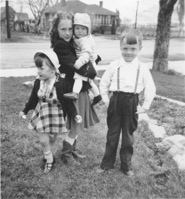 was temporarily walled in with cinderblock. Before the rest of the house was finished all of us four children shared the attic room. Dad and Grandpa had installed shelves on the walls for toys, and built child-sized furnishing. The view of that room most prominent in my memory is through the wooden bars of my crib standing next to the south-facing window. From that vantage point I could see my siblings’ beds and the narrow staircase to the first floor. Out through the window I could see the silhouette of Grandpa’s brick incinerator in his backyard next door, and I enjoyed a wide view of the wheat field beyond.
The Sunday Comics
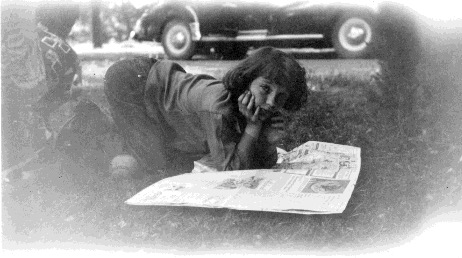 Sunday morning was a busy time around our house. We enjoyed a hearty breakfast of Zoom rolled-wheat mush, or eggs and toast, pancakes, or more rarely cold cereal ― on which occasions there would likely be some minor contention over who got to read the cereal box. Before getting dressed for Sunday School there was the full color comic section of the Deseret News to deal with. I couldn’t read them myself, but I loved looking over Charis’ shoulder at the cartoons while she read every word of every strip. Sometimes she would read them to herself from her choice spot on the floor near the heater register.
I’m not sure if I remember actually doing this, or if I just remember being told about it, but one such Sunday morning I apparently came up behind Charis and dumped a full glass of milk over her head, drenching not only her hair and nightgown, but the comics as well.
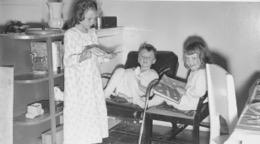 Charis loved to read. I also remember her writing, drawing, making paper dolls, sewing, working on one craft project or another, and practicing at the ballet bar that Dad had installed in our basement. Charis helped out around the house, and was often tasked with caring for Donnie, Julie, and me. In some ways life on Greenwood Avenue was idyllic for us children. We all enjoyed the frequent company of local cousins and friends, and with free reign of the neighborhood and surrounding countryside were seldom in want for companionship and outdoor adventure.
Palo Alto and Los Altos, California
Charis was just approaching her adolescence late in the summer of 1952 when we moved into our first Californian home at 215 Park Boulevard in Palo Alto. Even so, she seemed very much an adult to me. Our house was a small Eichler rental with the Southern Pacific commuter line running just behind our backyard fence. 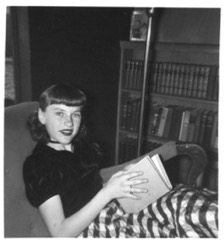 Patty was born when we lived there, and Charis loved caring for her. I may have been a little jealous of that.
We did not live in Palo Alto very long before we moved into our own newly-constructed home on Seena Avenue in Los Altos, where Charis entered her teenage years and was soon enjoying the frequent companionship of school and church chums. She never allowed her active social life to supplant time with her family. When it came to celebrating birthdays and holidays, she enthusiastically took the lead in planning and decorating.
Playing Clay
Charis loved playing games with the family ― cards, board games, Mr. Potato Head and the like, and we often “played clay” together. This peculiar practice probably began back in Utah, but my earliest memory of playing clay was on our yellow-topped Formica table in the kitchen of our Seena Avenue home. The only acceptable medium was “Klean Klay”, a specific brand of reusable sulfur-based plasticine. It came in four colors: red, yellow, blue, and white. We mixed blue and red for purple, yellow and blue for green, and white with a little red and yellow to produce flesh tone. Brown was made of an off-balanced mixture of all three primaries with an emphasis on yellow. Otherwise the brown would become a purplish muddy color, not very suitable for anything but monsters and bombs. (More on clay bombs, later.)
It has been suggested that Dad originated the game, and that wouldn’t surprise me, since he had studied architecture and was a skilled draftsman. The idea of the game was to create homes, and indeed entire neighborhoods, by rolling the clay into long thin snakes and arranging them on the table to form city plats and building floor plans. We used kitchen knives, Mother’s nut pick, Popsicle sticks, and lots of toothpicks. With all four of us sitting around the table it was not long before each had a furnished home, trees and gardens, cars, pets, and little families, all fashioned out of the clay. Then the fun would start as we commenced role play. We would visit each other’s homes; join in group dinners around tiny dining room tables, even molding miniscule dishes, cups, saucers, and even food. We would go to church, school, and take vacations, sometimes in open-air cars or busses, or in droopy-winged airplanes.
When it was time to clear the table for dinner, Charis and Julie were very particular about properly separating the colors of clay, rolling each into its own ball. Over time, however, a ball of purplish muddy colored clay grew and grew until it almost completely swallowed up the other colors. Then it was time to buy a new package or two of Klean Klay.
Regarding bombs, they were my most exciting contribution to the game. The older siblings were rather stingy with the remaining supply of cleanly colored clay, and usually tried to limit my stock to the composite purplish muddy colored material. That’s because I was a bit careless about mixing colors. As the clay neighborhood anathema, I would become bored with the serenity of life in “Claytown”, and begin secretly arming myself with bombs, and usually a nice big bomber or missile to facilitate delivery. Sometimes I would very quickly roll up my entire household into a giant atomic bomb, and without warning attack the rest of the neighborhood. For some reason, Charis and Julie were never amused. And Don, who was perhaps the most meticulous clay crafter of us all, would be furious. By the time I resorted to aerial warfare I was usually ready for banishment anyway, so from my point of view it was all well worthwhile.
Mount Lebanon, Pennsylvania
Leaving the West
Sometime early in the spring of 1955 our Dad was promoted to a corporate position within US Steel and accepted a transfer to the company headquarters in Pittsburgh, Pennsylvania. To this end we packed up and set out for our old home town, Midvale, where the three older kids finished the school year.
By the time school was out for the summer, Dad had rented a great and rather old house in Mount Lebanon, a southern suburb of Pittsburgh. We again boarded the family car for another long drive east.
Now, automobile travel was much different for families in those days. For one thing, older cars seemed inundated with exhaust fumes, and there was much more sway in the suspension than in modern sedans. Hilly or mountainous terrain brought on motion sickness. It was so bad that Mom often distributed halved Dramamine tablets to the children before we climbed into the old Nash. Just looking at those little yellow pills seemed to make me sick to my stomach. We never drove any distance without a coffee can or two in the car lest there wasn’t time to pull over when somebody might suddenly be taken by acute nausea. Charis was particularly susceptible, and usually sat in the front with Mom and Dad. On long trips a canvas water bag was always slung over the front bumper. The wind would cool it, and for some reason a drink of water from that bag seemed particularly refreshing. Unfortunately, it was often used to wash up after car sickness mishaps. So the inside of our Nash smelled of a curious blend of vomit and burnt petroleum.
Despite the discomfort and cramped conditions inside the car, and the inevitable car trouble or flat tire along the way, we were all happy to hit the road. Charis would lead us mile after mile in singing songs like “The Devil Went Down”, “The Horses Run Around”, rounds of “Row, Row, Row Your Boat”, and many of Dad’s favorite Boy Scout camp songs. We also played alphabet and word games, told stories and posed riddles to each other.
The Great House
Our home on 43 Ralston Place in Mount Lebanon was an old and mysterious house, with high ceilings, at least one stained glass window, a dark, dank, and rather musty basement, and a finished attic. While the house seemed enormous to me, it was in drastic contrast to our former home in California ― a modern and spacious ranch house. Julie attended Lincoln Elementary School right across the street. That was where I eventually entered kindergarten and began first grade the following year.
Dr. Stechschulte
Unfortunately something in the Pittsburgh environment disagreed with Charis and me. I recall that she frequently complained of headaches. I began to sense her frailty and vulnerability. I know I was a pesky little brother, but it frightened me when she was not feeling well. Of course, I was rather young and not aware of all that was going on, but I do remember that Charis was often kept home from school. As for me, I was asthmatic and allergic to a host of foods and inhalants, and was subject to frequent lower respiratory infection. Just about any day one would find either Charis or me on the living room couch with pillow and blanket. The steaming vaporizer laced with Kaz inhalant was almost a permanent fixture next to the sofa, inundating our home with the pungent aroma of menthol. When Charis’ condition worsened she spent more time upstairs in her room. In those days the doctors made house calls. I must admit that when Dr. Stechschulte visited I was relieved when he came to see Charis. When I was the patient it most certainly meant a shot of penicillin, epinephrine, or adrenalin – and always in the buttocks. Dr. Stechschulte’s syringe was a sinister metal and glass contraption with an enormous needle adorned with a square of alcohol-soaked gauze.
As a side note, one of my schoolmates, a boy living across the street from us and a best friend, came down with a relatively light case of polio. This was before the Salk vaccine, and of course everyone was terrified of contracting the dread disease. Mother was understandably alarmed because of Charis’ particular vulnerabilities, and because I had been exposed to the disease at school. The boy eventually recovered with only slight impairment, but in the meantime all of the children in the neighborhood were sent home from school, and parents were instructed to take them to the doctor’s office for gamma globulin injections. Mom took Julie and me to Dr. Stechschulte’s office for ours. The syringe he used for this shot was even larger than the one he routinely used on me at home. He injected what seemed like an endless volume of clear liquid into our little rear ends, working the plunger with tortuous slowness. It took two adults and the Doctor’s free arm to hold me down. I don’t recall if Charis was subjected to the gamma globulin treatment, but I do remember how worried Mom and Dad were over her uncertain health.
“Primary” at the Old Swiss School
When Charis was feeling well she was happily her old social self. She seemed to have lots of friends, and was quite active in our church. In those days all of the Mormons in Pittsburgh met in what we called the “The Old Swiss School”[1]. On Primary day, a spacious large room – sort of a recreational hall I think – was divided by a matrix of curtains suspended from the ceiling into perhaps half a dozen or more little compartments. The curtains were withdrawn during the opening exercises, and then drawn closed for the various age group classes. During the assembly I was proud to see my big sister leading the children in song. She had cut out a frowning face from construction paper. When it was turned up-side-down, the downturned wrinkle in frowning face’s forehead became a smile. Along with this prop was a cute little song that every Mormon child learned. Charis was also the first in my memory to lead me in “Itsy Bitsy Spider”.
The drive to the Old Swiss School was not so pleasant as the Primary experience itself. The building was east of the big city, so to get to church we had to cross the Monongahela River, and to get to the river we usually drove through the Liberty Tunnel or “Tubes” as it was called. I loved the ride through the Tubes, but for some reason Dad sometimes took a different route over Mount Washington. Perhaps the Tubes were closed for maintenance. Anyway, the mountain road was narrow and windy, and often resulted in somebody chucking up their breakfast on the way. As a result, for most of my life I’ve associated church with motion sickness.
The Theatre
Among Charis’ many talents was drama – really more accurately play acting. The attic in our Ralston Place home was finished with light blue plaster walls and a split-level floor. The higher part of the floor served well as a stage for plays in which Charis, Julie, Don, and sometimes their friends, took parts. I don’t recall details of the plays themselves, or if they were all performed adlib. I do, however, clearly remember an old steamer trunk full of costumes, many of which were worn by our mother during her days as a dancer. My favorite article was a gold-fringed velvet shawl with variegated concentric circles of rich colors against a black background. There was a red Harpo Marx wig and a black theatrical beard along with several pairs of high heeled shoes, sequenced slippers, some old boots, frocks, skirts, and silk blouses. Charis and Julie got a kick out of dressing me up as a gypsy with earrings and bangles, and sometimes as a girl complete with makeup. I remember one time borrowing Mother’s crystal powder bowl. With little imagination it could be taken for a crystal ball, especially when placed in the middle of the velvet shawl draped over a card table. Charis fashioned a turbine from an old scarf out of the steamer chest, and mounted it atop my head, securing it in the front with a large bejeweled pin. Draped in this exotic garb and wearing the black beard, and with the crystal ball before me, the girls coached me in the dramatic art of fortune telling.
Near the top of the attic stairs was a little storage room where lots of dusty old clothes were hung, and on the floor boxes of old post cards, appliances, an old typewriter, and a wooden “chest” full of costume jewelry. We could keep ourselves amused for hours on end in that attic.
The Pillow Storybook
Our bedrooms were on the second floor of the house. Mom and Dad’s room was the largest, and the second largest was shared by Charis and Julie wherein they also shared an old double bed. Don and I shared the smallest bedroom, but at one point Mom and Dad decided to move Patty’s crib into our room with me, and move Don into a tiny room that Mother formerly had used for sewing. There was barely enough space there for a twin bed, a dresser and a desk. His room had a terrific front-facing window that looked out over Ralston Place and Lincoln School. Don was delighted with the new arrangement. For one thing, he was the only member of the family with a room of his own, and for another, he no longer had to put up with me.
From time to time Charis and Julie would invite the rest of us to crowd in with them under their sheets for a bedtime story. On at least one occasion I remember securing the spot right next to Charis so I could get a better look at the pictures in her great story book. Sitting up in bed she reached around and pulled the book out from behind her back where it was hidden. Soft bound with a white fabric cover, it looked strangely like a pillow until she folded it in half on her lap. Then the magic began. When everyone was still, she ceremoniously opened it ― its ancient binding creaking like the door of a haunted house. Then, scanning left to right and licking her index finger, she slowly turned through the pages searching for the particular story she had in mind for that night. We watched her with anxious anticipation until she at last found it and began reading to us. The stories were always beautifully illustrated, and indeed by Charis, herself.
Games
With limitations strictly imposed by Dad on our TV time, games were far more often the focus of our evenings at home. The old Sears Silvertone set received only one channel, anyway. We played “Finance and Fortune”, a board game very similar to Monopoly. We also played Parcheesi, Rummy, Fish, and Old Maid. Charis was a competitive gamer, and insisted on everyone’s compliance with the rules.
Boy Crazy
When we were permitted to watch TV, we did so together as a family. Regular programming included “The Ed Sullivan Show” and “I Love Lucy”, and I remember one night watching “Hit Parade”. On this occasion the show was hosted by Johnnie Ray. Charis swooned when he sang. I thought it was all rather disgusting, and would much rather have been permitted to watch “Disneyland” at my friend’s house, where they had a rooftop antenna and got channel seven. Whether it was a crooner on TV or radio, some new missionary at church, or a boy from “Mutual”, Charis, to my recollection, always had a crush on somebody.[2]
Marionettes, Rosettes, and Paper Mache
In preparation for church dances, parties, and other such events, Charis often volunteered to fashion the decorations. On more than one occasion she showed us how to cut streamers from rolls of colorful crepe paper, making flowers and other ornaments. We would sit around the kitchen table for hours following her example. My flowers usually fell apart, but Charis, Julie, and Mom were real pros, and before long had made boxes full.
With Dad’s help, Charis made several marionettes. Dad cut out the leg, arm, and body, and head pieces from pine. Armed with pliers we joined them together with screw eyes. She painted their faces, and with Mother’s help the girls made clothes and fashioned hair from yarn. I don’t remember exactly the circumstances. Perhaps one of the other siblings can shed some light on that project.
Charis was also a great hand with papier-mâché. Again, the girls made masks, dolls, puppets, hats, etc. Whatever they were making, I usually helped out by tearing strips of newspaper and smearing them with slimy wheat paste. Charis finished her puppets and papier-mâché figures with her characteristic panache – eyes painted with a sideways glance, highlighted lips, lots of rouge on the cheeks, and a flourish of loose hair over the forehead. As long as I can remember, she never quite developed the knack of portraying masculinity in her figures. Her rare male subjects tended to look to me like girls merely dressed up as boys.
Thatcher, Arizona
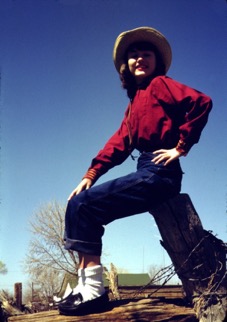
Charis’ health deteriorated, and at one point she had to be hospitalized for what seemed to me an awfully long stay. Dr. Stechschulte sternly warned our parents that a warmer and drier climate was necessary if Charis were to recover, and for the sake of my respiratory health. So in 1956 Dad arranged to move the family to the little town of Thatcher, Arizona. Again, the move occurred during the school year, certainly after Christmas — perhaps early spring. Dad drove us to our new southwestern home in our green and white 1952 Buick Dynaflow sedan. During the night we ran into a terrible snowstorm on Route 66 while crossing the Texas panhandle. For many frightening miles we sat wide-eyed and high on the edge of our seats as Dad threaded the car through a blinding vortex of snow.
 The Cottage
Dad had rented a tiny white cinder block or stucco cottage near the edge of town.[3] There was no bathtub, and the shower stall was made of sheet metal painted a sort of brick color ― badly faded with lime deposits. I remember that upon its first usage a scorpion or centipede was discovered abiding near the drain. This caused a general household panic. The adjustment from our great house in Pennsylvania to this dingy little shack must have been difficult for Mother.[4]
Our landlady, “Aunt Lottie”[5], owned our cottage along with a few others on her property. She lived in the big house nearer the street. She seemed a bit gruff at first, especially when it came to small children teasing her ill-tempered geese or running through her gardens, but we eventually found her to be tender hearted and genuinely concerned for our safety and wellbeing.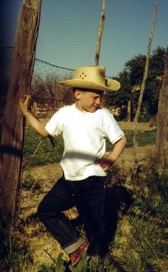
Likewise we soon came to love our Arizona cottage, and more particularly, the quaint little town of Thatcher. We walked everywhere – to school, to church, shopping – and we felt safe wandering almost anywhere about town. For the sake of our health, however, Thatcher Arizona was a disappointment. Charis was still on a medical roller coaster, and with a cotton field next door my allergies actually worsened.
“The Country Caller”
Again, I was very young, and all of this happened a long time ago, so I will do my best to relate the story of the “Country Caller”.[6]
Charis was always cooking up some new scheme by which to express her creative talent. One day she decided we were all going into the publishing business. This required a cookie sheet, some Knox gelatin, perhaps from the local grocer’s or drugstore, and from the stationer’s a box of mimeograph ditto masters – all the components of a homemade hectograph. As I recall, we had both red and blue masters, so our magazine was printed in two colors.
Charis, as editor in chief and head layout designer, invited each of us to contribute. I have some recollection of drawing a small picture in the way of a comic strip. Most of the work, however, was Charis’. If I remember correctly the first edition[7] consisted of just a few pages. We had to set out the printed sheets all about the kitchen to dry, after which we assembled and stapled them into finished magazines. Each of us was assigned an area of Thatcher to canvas, and each given an allotment to sell door-to-door. I don’t recall the price, but it was probably a few cents to a nickel per copy.
My assignment was the southwest quadrant of town. I sold some if not all of my papers. On the way home was a small corner grocery store. With a handful of coins in my pocket I could not resist the temptation to stop there and reward myself with a “Missile Pop” – a large red white and blue Popsicle in the shape of a bomb. It was more expensive than a regular Popsicle – perhaps as much as a dime – and for me a rare treat. I think while I was at it I also bought a nickel pack of corn nuts. Anyway, I returned home proud of my business acumen but not prepared for the scolding I received from the chief for having spent the profits.
◊◊◊◊◊◊
We hadn’t lived long in Thatcher when we received news that our Grandmother Wagstaff had passed away with a stroke. This was early May of 1956. With little time to prepare, Mom drove us north to Midvale for her mother’s funeral.[8] On the way, a state trooper pulled us over for speeding. I remember hearing him complementing Mom on her good looks and red hair. That made me very uncomfortable. Not surprising, though, he let us go with a warning.
Charis sat in the front with Mother, and Patty sat between them in a flimsy little car seat with metal bars bent over the seatback. There were no seatbelts, and little thought was ever given to what happens inside an automobile in the event of an accident. Donnie and Julie had the backseat to themselves, and my spot was the shelf just beneath the rear windshield, where there was just enough room for me to lie fully reclined. I remember as we drove through the night overhearing a conversation between the Mom and the older siblings about someone or another being diagnosed with cancer. That was my first exposure to the “C” word, and I was quietly terrified. Somehow I got the idea that the tip my sternum was actually a tumor ― a fear that persisted for years afterward.
After Grandmother’s funeral we brought Grandpa back to Arizona with us. I don’t remember how long he stayed, but I doubt it was very long.
By the time school let out for the summer we were all little Arizonans. I remember the Fourth of July parade in Safford[9], the neighboring town, followed by a grand rodeo. Despite the scorpions, centipedes, venomous snakes, and the dread Gila monster over which Charis was particularly concerned, we often explored the surrounding desert, getting up close to the wonderful rock formations, the cactus, and strange little creatures. I for one would have been perfectly happy to spend the rest of my life there. Charis made plenty of friends in Thatcher and would probably have been content remaining there, as well.
California
Deodara Drive in Los Altos
All this time Dad was still working in Pittsburgh, visiting us whenever he had the chance.[10] We children looked forward to his visits, but Charis was particularly happy to see her “Daddy”.
Before Fall, we packed up again and drove back to California, moving into a newly constructed home in the Vista Los Altos subdivision. We were its first residents. Our house is still there at 2168 Deodara Drive. This must have been in August or September of 1956.
Stanford Hospital
My memory of this period is a bit sketchy on the details, but I think Charis was having a pretty rough time. Deferring the medical facts to my mother and older siblings, I will restrict my comments respecting her health to my impressions as a young boy. Shortly after our move, Charis was admitted to Stanford Hospital in Palo Alto. Prior to entering her room for a visit, we were cautioned that Charis was in “reverse isolation”, meaning that she was extremely susceptible to infection, and that every care had to be taken to protect her from exposure. Her room was dark and quiet. To me she looked so tiny lying in that hospital bed – like a little child. This shocked me at the time, and I fought back tears and resisted thoughts that we might lose her. She was elated to see us, and despite her profound weakness she sat up in bed for our brief visit.
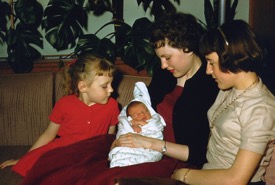 One day when I came home from school I saw her at the kitchen table soaking her hands in warm melted paraffin to sooth her arthritis pain. I also remember her sitting in the living room on our three-piece sectional ― her face round and puffy with fluid retention. Suddenly a tiny stream of water began to squirt out from one of her shins. She had retained so much fluid that her skin literally sprung leaks. She explained to me that it was caused by her medicine ― no doubt a side effect of the cortisone therapy she was undertaking. I once asked her why she didn’t just quit all her pills. I had the notion that if she just stopped taking the medication she would naturally get better. Of course, I didn’t know what I was talking about, but that was my impression at the time.
Party Girl
When she could, Charis attended classes at Fremont High School in Sunnyvale. She was an excellent student. As usual she made friends at both school and church. They visited her at home when she was ill, and came out to the parties she hosted in better times.[11] 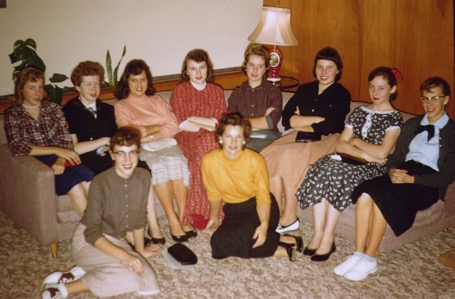
We had a large family room in our new home perfect for entertaining. I remember on one occasion a taco party, where the girls gathered to make tacos the old fashioned way, frying the folded tortillas with the filling already inside. On another occasion she and her friends held a taffy pull in our kitchen. They all wore butter up to their elbows. It was, I’m sure, a lot of fun, but rather difficult work for Charis.
Suitors
Despite all of this, Charis had suitors. I think one young man tried to get to her through me. He came over to visit and saw me at the kitchen table assembling a model airplane. He told me he used to love putting together model airplanes and asked me if I’d like to have a few of his. On his next visit he brought me a large cardboard box of beautifully painted military aircraft models –a dozen or more – all in 1:48 scale. Before long I had suspended many of them by fish line from the ceiling of my room in a great dogfight. He certainly had my vote.
Another one of her boyfriends gave her a book, a novel by Frank B. Gilbreth entitled Of Whales and Women. I’m not sure if she wasn’t crazy about the book, or about the young man, but she gave the book to me. It was one of my favorites.
Shalimar
Dad and mother took every opportunity to encourage Charis, and to fuel her interests whatever they might have been. To that end they were willing to make great sacrifices. I don’t recall the circumstances, but a pet skunk somehow showed up on Charis’ wish list. Mother’s enthusiasm about pets in the house was transparent at best, and my father must have considered keeping a skunk indoors – even one surgically deodorized – shear insanity. Nevertheless, a little skunk was brought home one day to Charis. She named him “Shalimar”, ironically after her favorite perfume.
When he wasn’t being caressed in Charis’ arms, Shalimar spent most of his daytime hours in Charis and Julie’s room, caged and asleep. I don’t know if Charis deliberately let him out of his cage at night, or if he figured out how to unlatch the cage door on his own, but he often wandered about the house when the rest of us were asleep. One night I was aroused from my slumber by the clicking of Shalimar’s claws on the linoleum floor of my bedroom. I looked toward the sound and saw two little eyes aglow in the dark. The following morning I walked gingerly down the hall with carefully downcast eyes. Our house took on a faint but persistent odor – not so much of skunk scent, but more like that of rodent.
It soon became apparent that there was something wrong with Shalimar. He developed a limp, due perhaps to an immunization shot gone wrong, but I don’t think he lasted too long.
The Ten Commandments
One evening around this time our entire family donned Sunday best and drove to a local theatre to see Cecil B. DeMille’s 1956 production of “The Ten Commandments”. It was a grand affair. Each member of the audience was greeted in the lobby and offered the purchase a beautifully printed full-color booklet about the making of the film. Dad bought one despite the added expense. It was full of high-quality prints of scenes illustrationed by Arnold Friberg. These paintings were done in the same heroic style in which he illustrated the Book of Mormon. Friberg was partially credited for costume and set design. The film was rich – rich in action, drama, music, scenery, and possibly for the first time exposed the modern world to the true grandeur and elegance of ancient Egypt in striking Technicolor. The effect was not lost on any of us. Charis, a long-time and devoted Egyptophile, was particularly inspired by the spectacle and, for years thereafter, was almost obsessed with the beguiling mystery, history, religion, and art of that long lost culture.
Dad rode daily to and from San Francisco on the Southern Pacific Commuter. He usually walked from the station on Third Street to his office on Market. On the lookout for books old and new that he thought might help energize Charis through her extended periods of convalescence, he often stopped on his way back to browse in a used book store on Third Street. Thus a collection of works on Ancient Egypt graced our bookshelf, including several colorful coffee table editions from Time/Life, National Geographic, and the like.
Gifts
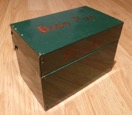 One Christmas Charis gave me a dark green metal recipe box, designed for 3” x 5” index cards. On the outside she wrote with red nail polish, “ Bob’s Box ”. Inside were some coins, stamps, and a few marbles. I cherish it to this day. That same Christmas she gave me her entire coin collection, consisting of a folder of mounted pennies dating back to the early 1900s, a folder of nickels, and another of dimes. In those days I had a terrible time saving money and must shamefully admit that I eventually spent most of the coins. I kept some of the more valuable specimens, especially those minted in San Francisco, as well as the steel pennies from the WWII era. Years later when Charis learned of this she was sadly disappointed in me. She should have known.
The Pink Rambler
The next year Dad purchased a brand new car for the first time in his life, a pink 1958 Nash Rambler “Cross Country” station wagon. While the “Desert Rose” color scheme matched 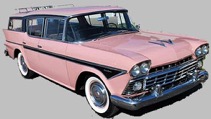 Mom’s favorite dinnerware in both name and hue, it was Charis’ choice – she apparently went car shopping with Dad and he let her pick the color. Speaking for my older brother, Don, we boys thought it revolting, and were mortified to be seen in it. What was worse, the car turned out to be a lemon. The transmission and rear-end differential failed within the first year. The choice of a Nash was a bit surprising to Don and me given Dads frustration with his first one, a two-tone sky blue automotive catastrophe purchased from his brother-in-law around the time we first moved away from Utah.
Providentially, Mother had insisted that seatbelts be installed at the time of purchase, and what’s more, she stipulated that all passengers buckle up. Charis was by that time attending classes at San Jose State when in 1960 the pink Rambler met its demise at her hand. She was sometimes permitted to drive it to school. On her way she was to drop Don, Julie, and me off at our respective schools. We lived on a street corner, and the garage and driveway were located at the side of the house. I remember one such morning her backing the loaded car out onto Wistaria Lane, and then turning down toward Deodara Drive onto which she made a hard right. The only problem was that she had become distracted in a conversation with Julie and forgot to straighten out the wheel after making the turn. The car headed up the embankment and over the concrete steps in front of our house. She didn’t take out the mailbox standard which Dad had set securely in a footing of concrete, but it scraped up and indented the entire passenger side of the car from the front fender to the tail fin.
That was it for the pink atrocity. I went with Dad when he drove the beast for the last time to Spivey Ford in Mountain View and traded it in on a 1960 Ford Country Squire equipped with a “Police Interceptor” 352 V-8 engine. Oh yeah! This was more like it. Unfortunately for Spivey, he neglected to carefully examine the Rambler, which Dad had parked close alongside the Spivey’s showroom wall. Shortly after arriving home with our new Ford, Dad received a phone call from Mr. Spivey. He was livid about the body damage, but Dad told him a deal is a deal, and that was that.
Rapid City, South Dakota
Around this time Charis met her future husband, Bill Southwell, an LDS missionary serving in the bay area. I entered High School in 1963. The following year US Steel consolidated many of its divisions, and Dad accepted a corporate position back in Pittsburgh. Meanwhile, Bill and Charis married, and moved to Provo, Utah, attending classes at BYU. By the time I graduated from High School in 1967, Bill had earned his doctorate and accepted an academic position at a college in Rapid City, South Dakota.
Charis’ Personal Assistant
Late in the following summer when I wasn’t being particularly productive, Charis invited me out to their home in Rapid City for an extended stay. By that time they had adopted Paula, but Charis’ wasn’t well, and she and Bill thought I might be of some help around the house and with the baby. I accepted and headed west on a Continental Trailways bus. This visit turned out, in many ways, more to my benefit than theirs.
Charis assigned me a number of tasks around the house. I helped with the housekeeping, kitchen chores, prepared some of the meals, and I helped take care of Paula. Charis had me working in her garden, as well, and even got me to dig a tree out of her front yard.
Charis and Bill provided me with a small cash allowance while I was in Rapid City, and Mom and Dad had advanced me a nice little wad of spending money for the trip. I was able to buy a little German-made Framus guitar at the local music shop, as well as a Hohner soprano recorder. I taught myself to play both. Paula got a big kick when I played and sang to her. She would jump up and down singing out as loud as she could until I stopped strumming. She’d stand quietly waiting for me to start up again, and then instantly would rejoin the cacophony.
Bill had been appointed branch president by the LDS “Lamanite” mission in South Dakota, where he then lead a congregation of Sioux and other Native Americans of various tribes in the area. Charis was in love with the Indian people and was dearly loved by them in return. I became likewise enamored. She introduced me to a number of her friends, including Margaret One Bull Tremmel, an adoptive granddaughter of Sitting Bull. I watched members of her family perform Indian dancing and music at a Powwow.
The Movies
Charis introduced me to a girl of the Crow Nation named Nikki Little Creek and arranged a double date at the movies for the four of us. Charis let me pick the show. I can’t imagine why, except there probably was not much choice in Rapid City in those days, but I selected “Barbarella” starring Jane Fonda. I had been intrigued by previews featuring a scene wherein swarms of vicious little dolls with piranha-like teeth were eating people to the bone. When I made the suggestion Charis told me in no certain terms that she hated Jane Fonda. Nevertheless, Bill took us to see “Barbarella”, but we had no idea what we were getting into. During the opening credits, Jane Fonda stripped 360º to the skin while tumbling weightlessly in a spacecraft. Charis was mortified. I must have apologized a dozen times. The embarrassment for Charis and Bill had to have been agonizing, especially considering their leadership status in the church.
One of Charis’ favorite movies at the time was “Zorba the Greek”. She and Bill used to do the Greek Dance thing in circles around their living room in Rapid City to a recording of the soundtrack music. At some point, either on TV or at the theatre, we saw “A Thousand Clowns” starring Jason Robards and Barbara Harris, a film Charis passionately loved and one of my favorites that I revisit regularly in her honor.
The University of Bill and Charis
Charis and I worked together developing an idea to produce an animated cartoon featuring Lewis Caroll’s “Jabberwocky”. We often discussed religion, art, philosophy, and current events. We watched the CBS evening news on television, and Charis was incensed by the political bias evident in Dan Rather’s reporting. Her favorite General Authority, she told me, was N. Eldon Tanner. He was “such a sweet and humble man”, she said. Charis also admired Hugh Nibley, possibly because he was also an ardent Egyptophile. I think she introduced me to one of his works on the Book of Mormon. She also lent me a copy of Durant’s History of the Catholic Faith.
Bill bought me a college text book on physics, and I purchased a copy of a Schaum’s outline of algebra. With Bill’s coaching I spent much of my spare time in Rapid City studying out of these books. This proved a great advantage to me a few years later when I took my entrance exams at Duquesne University. I just about aced the math section.
That Fall Bill and Charis decided to drive me back to Pittsburgh. The weather was terrible with early ice and snowstorms and we were forced to spend a night in a motel somewhere in Iowa.
Last Farewell
I think it was my contact with the Indian people in Rapid City that spawned in me a desire to return to South Dakota as an LDS missionary. Shortly after returning home I was called in for an interview with the Stake President about that very possibility. In time I received a mission call, but to my disappointment it was to the “white” Arizona Mission. Sending missionaries with chronic health problems to Arizona may have been a matter of automatic Church policy, for headquarters disregarded my request to serve among the Indians.
In September of 1969 I departed for training at the Mission Home in Salt Lake via Rapid City. I don’t remember if I flew that leg, or motored in with my folks. In any event, I am sure that my mother was staying there at the time helping Bill and Charis with the baby. I spent a few days with them, said my good-byes, and boarded a plane bound for Casper Wyoming and points west. Charis was too ill to accompany us to the airport, so in my last glimpse of her she was standing behind the screen door of her Rapid City home, tearfully waving farewell.
The boundaries of the Arizona Mission extended west, north, and east of the state boundaries and included Las Vegas, Nevada, my first territory. The following January I was transferred to the Mesa district in Arizona. My companion and I were billeted in a pink and white 28-foot trailer home known affectionately among the Elders as the “Honeymoon House”. It was located not far from the ASU campus. My first companion in Mesa and I got along sensationally, but he was replaced about a month later by a fellow to whom I found it quite impossible to relate. For one thing, he insisted on playing tape recordings of the Ray Conniff Singers from dawn to bedtime. He had an active social life for a missionary and regularly visited with his favorite families in the ward, doing just enough missionary work during the day so that we’d have something to put down in our weekly reports.
It was late one such afternoon, March 7th 1970, to be exact, that I decided to bicycle back to the Honeymoon House by myself despite the general mission rule barring separation from one’s appointed companion. When I arrived home I noticed a note wrapped with a rubber band around the screen door handle of our trailer. I sensed immediately what it was all about even before I opened it. My father had been trying to contact me through the mission office, and I was to call him collect as soon as possible. Dad told me the sad news that Charis had passed away in a Pittsburgh hospital the day before. He told me that her funeral was to be held in Rapid City, and that he had already warned the mission president that I would probably insist on attending with or without official permission.
The note also instructed me to contact the mission home. The Mission President called me in for an interview. He explained that the mission rules forbade leaving the field even for the death of an immediate family member. Before I could protest that the rule meant nothing to me, he said that he had decided to make an exception in my case. He asked me for my solemn promise to return. He also asked me about Charis. In the course of our conversation I told him of her love for the Sioux people and explained that it had originally been my desire to serve my mission among the Indians. His response was a welcome surprise. Apparently the Southwest Indian Mission was short-handed and had sent requests out to other domestic missions asking for volunteers willing to transfer. He said he’d see what he could do on my behalf.[12]
Once in Rapid City, Bill asked me to design a program for the funeral services. He had it printed that day.
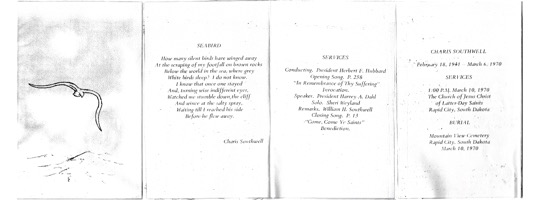
I spent a sleepless night before Charis’ funeral in a motel, sharing a room with Bill and little Paula. That night I wrote the following poem in my Missionary Journal:
Snow had fallen all-night long
To the breath of my sister’s sleeping child,
Who turned and sighed
As I stood gazing outside at the dawn
Through the frosted pane of a motel window.
Long morning shadows yawned of trees
Across the cold, still, laying of snow.
And I saw the shadows of mourners flow
Over my sister, cold and still,
Dressed in a gown of linin and lace,
White in a casket molded of snow.
Though only twenty-nine years,
And the world barely knew,
Let it forever be known,
That in March the snow came
To my sister’s funeral,
And the trees mourned in dawn.
Our entire immediate family was there, as were many of the local Indian church members.
I cannot find the words to convey my personal grief over her loss. I still weep. The love she gave and received during her brief twenty-nine years still thrives in the memories of all who knew her. When I think on her now, and I often do, I wish she could have known and smiled upon my Mary Jo, our children and our grandchildren, and that they could have enjoyed the privilege of knowing this special sister of ours.
Charis’ Last Letter to Me
Bill Southwell recently shared a hand-written letter with me. It was written by Charis while I was serving in the LDS Arizona Mission. She completed in two sessions but never mailed it.
Oct. 16, 1969
Dear Bob,
We enjoyed your letter. We’re all wondering how much longer the Las Vegas mission area will last. I hope you really aren’t giving everyone such a bad time.
I had quite a little stay in the hospital. My blood pressure has gone from 230 to 110 – quite a drop and a bit hard on me.
It’s at 170 now – fairly good. I’m very weak however, and I still have dizziness. I hope you won’t forget to pray for me. Oh! How I need spiritual support. I’m trying hard to get better but it isn’t easy.
Mother left for home this morning. She’s been a great help to us. She just about got Paula trained while she was here. She is a remarkable worker and was a great help. I surely hate to see her go.
We are thinking very seriously about moving to Pittsburgh. Bill has applied with Gulf Oil. It would help us to be near the folks, and I need to be someplace large enough in case I need the use of a kidney machine. Of course all this depends on employment and we just have to wait & see.
We had a lovely snow & Bill & Paula built a snowman. Paula made the head. She is so full of life and happy. She’s really starting to talk a lot now.
Oct. 22, 1969
Sorry I didn’t get this in the mail. But it’s just as well as I am feeling quite a bit better. My pressure is still up & down, but down now more than ever.
If Bill gets an offer from Gulf Oil, we will pretty definitely [move] to Pittsburgh. I’m not crazy about Pittsburgh, but I need to get near a good Dr. & a kidney machine. We’ll probably move right away.
We certainly appreciate your writing. I know you really don’t have time. I hope you had your baptism & that things are going well.
All Our Love,
Bill, Charis & Paula
[1] . I have searched the Internet for any reference to “The Old Swiss School” in Pittsburgh without result. According to Mother it was on Wallingford Street, but she understands it to have been torn down. I believe she is right. Using Google Maps street view, I virtually “cruised” up and down the Wallingford, a street lined with turn-of-the century mansions. These looked familiar to me, but I was unable to identify any building as the “Old Swiss School”. I’m sure I would recognize it if it were still there.
[2] According to Mother, Charis had a “hopeless crush” on Orin Hatch, now serving as a US Senator from Utah, not to mention the heavy torch she carried for Dale Davis throughout her entire adolescence. Charis admitted in her diary that she was an avid fan of Elvis Presley and Jerry Lewis.
[3] Charis’ diary has proved a great resource for details. For years I looked high and low for our Thatcher street address. Our mailing address was “General Delivery”, so the street address appears on no correspondences. According to Charis’ diary, however, Aunt Lottie’s compound was located at 624 2nd St. Mary Jo and I visited there about 20 years ago, and by pure instinct I found the cottage, and we visited with its then current resident. He had known and clearly remembered Aunt Lottie. Using the address from Charis’ diary, I again tried to find the place using Google Maps, but was unable to find any recognizable property at that address. I called the Thatcher town hall, and was told that the streets had all undergone renumbering, and the 624 2nd St. address had been changed to 3724 W. 2nd St. Aunt Lottie’s house and the rentals were torn down in 1994, so the only photo is in our 8mm family home movies taken back in 1956.
[4] The problem, according to Don, was that United States Steel initially turned Dad down on his request for a transfer back to San Francisco. Determined to see the family in a more healthful environment even at the expense of his career, he gave his employer notice. The stark little cottage was apparently a necessary measure of economy in those uncertain times.
[5] Charlotte Elizabeth Smith Moody (b. 1881, d. 1963)
[6] I had remembered it as a newspaper name the “Thatcher Gazette”, but stand corrected after reading Charis’ diary.
[7] I remember only one edition, and this was confirmed for me in Charis’ diary.
[8] According to Mother, she actually drove the family only as far as the Phoenix airport, where we met Father, who drove us the rest of the way to Midvale. Dad also drove us, along with Grandpa Wagstaff, back to Arizona. On the doctor’s advice, Charis stayed home.
[9] According to Charis’ diary, the parade and rodeo took place on March 23, 1956, and not in celebration of Independence Day, as I had remembered. I have not been able to find any special significance in Safford or in the State of Arizona regarding March 23rd. The town’s on-line city calendar has nothing special scheduled in March.
[10] Again, Don recalled that during these trips he was interviewing for jobs in the area. Realizing that Dad was not bluffing when he gave notice, the management at US Steel reconsidered and, at the last minute, offered him a managerial job with his former Columbia Geneva Division in San Francisco.
[11] Charis mentioned in her diary that one of her parties was attended by 27 of her friends.
[12] The opportunity to transfer to the Southwest Indian Mission did come to me about six weeks after returning to the field. I worked among the Jicarilla Apache, Navajo, Hopi, and Havasupai people of the southwest.